Grant Road, Mumbai, India — Trade Partners Only
+91 99846 05380 [email protected]
0%

The B2B wholesale eyewear market is broad, practical, and constantly changing. Retailers need more than attractive frames. They need dependable quality, useful designs, stable pricing, and products suited to local customers. A boutique may prefer slim acetate frames. A sports shop may need secure performance eyewear. An optical store may focus on prescription-ready styles.

Neil Blumenthal, Warby Parker co-founder and an experienced eyewear entrepreneur, has said, “The future of retail is not online or offline. It is both.” This idea also applies to B2B wholesale eyewear. Buyers now compare catalogues online, inspect samples closely, and expect efficient communication afterward. However, digital convenience cannot replace physical evaluation. Hinge tension, frame balance, lens clarity, and packaging quality still matter.

This guide examines ten important types of B2B wholesale eyewear. These include optical frames, sunglasses, blue-light glasses, reading glasses, children’s eyewear, sports eyewear, protective eyewear, luxury-inspired collections, eco-conscious frames, and clip-on designs. Each category serves a different commercial purpose. Some support everyday vision needs. Others create seasonal sales or attract specific customer groups.

The categories may overlap. That is worth admitting. A sustainable children’s frame can also be lightweight and prescription-ready. A sports frame may include tinted lenses and protective features. Product labels alone do not guarantee strong sales. Retailers should assess materials, fit, lens performance, compliance documentation, minimum order quantities, and return policies. Small details matter. A loose hinge can damage customer trust quickly.

The right assortment depends on store positioning, customer age, climate, budget, and sales channels. There is no universal winning list. Careful testing remains essential.
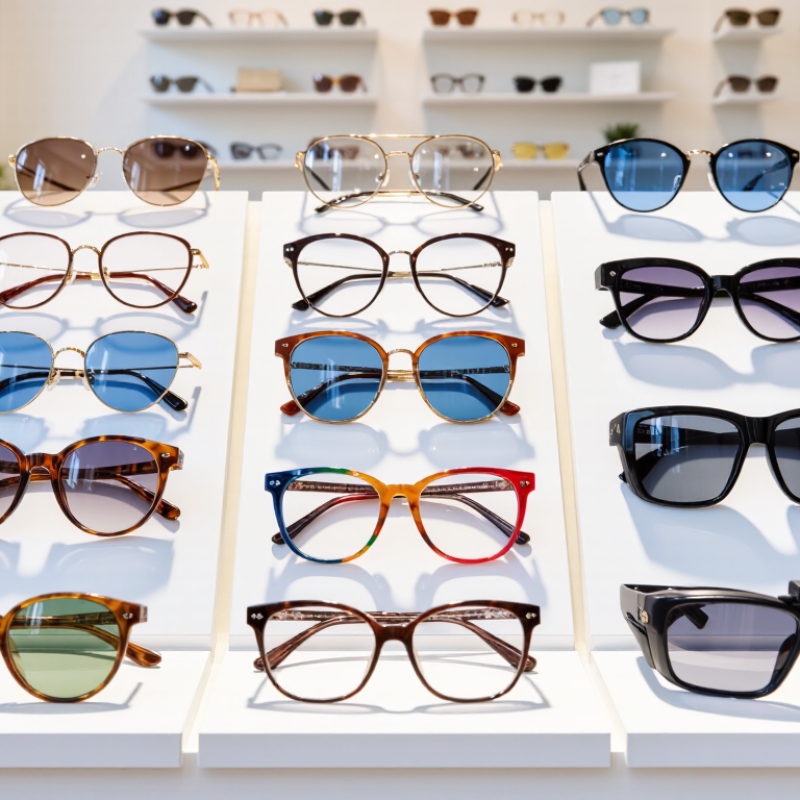
What Are the Top 10 Types of B2B Wholesale Eyewear?

Defining B2B Wholesale Eyewear and Its Main Market Categories

What Are the Top 10 Types of B2B Wholesale Eyewear?

B2B wholesale eyewear means selling eyewear in bulk to retailers, optical stores, online sellers, and professional buyers. Unlike consumer purchases, wholesale deals involve quantities, sampling, production schedules, packaging, and repeat orders. A buyer may inspect a sample frame under bright store lighting, checking hinge tension, lens clarity, surface finish, and comfort. Small defects become expensive when multiplied across hundreds of units.

The main market categories include optical frames, prescription-ready frames, sunglasses, polarized sunglasses, reading glasses, blue-light filtering eyewear, sports eyewear, children’s eyewear, protective eyewear, and clip-on or convertible designs. These categories can overlap. For example, a sports frame may also include polarized lenses, while a children’s frame may require protective materials. Each segment has different expectations for fit, durability, lens performance, and packaging. Regional product requirements should be verified before distribution.

Pricing alone is a weak buying guide. A low unit cost may hide inconsistent sizing, fragile hinges, or slow replacement support. Experienced buyers compare material specifications, quality-control records, minimum order quantities, and delivery reliability. They also request physical samples before confirming a large order. That step is often skipped. It should not be. Even careful buyers can misjudge color, weight, or temple pressure from product images. Reliable wholesale sourcing depends on clear specifications, documented inspections, and honest communication when a design needs improvement.

Exploring the Top 10 Types of Wholesale Eyewear

Exploring the Top 10 Types of Wholesale Eyewear

helps buyers match products with real customer needs. Each category serves a different purchase occasion and price expectation.

Prescription optical frames remain essential for everyday vision correction.

Polarized sunglasses reduce glare near roads, water, and bright shop windows.

Fashion sunglasses add seasonal color, oversized shapes, and stronger visual appeal.

Blue-light glasses attract office workers and frequent screen users.

Reading glasses offer convenient magnification in several strengths.

Children’s eyewear needs flexible materials, secure hinges, and smaller measurements.

Sports eyewear should provide stable nose support and impact-aware construction.

Safety eyewear serves industrial buyers requiring protective coverage and comfortable wear.

Clip-on lenses offer adaptable styling for optical frames.

Rimless or frameless designs create a lightweight, minimal appearance.

Material testing matters.

Acetate can provide rich color and dependable shaping. Metal frames may feel refined but require careful adjustment.

Buyers should inspect hinge movement, lens clarity, nose-pad alignment, and packaging consistency. Ask for size charts and sample units before placing large orders.

Small defects become expensive when multiplied across hundreds of pieces. It happens.

Wholesale success also depends on demand timing.

Spring may favor translucent colors and lighter shapes. Colder months can support darker lenses and stronger frame profiles.

However, predictions are never perfect. I would review sales data, customer feedback, and return reasons together.

A low-cost frame is not truly economical if it causes repeated complaints.

Reliable suppliers should communicate material details, production tolerances, and shipping conditions clearly.

Comparing Materials, Designs, and Target Customer Groups

What Are the Top 10 Types of B2B Wholesale Eyewear?

Wholesale eyewear works best when material, design, and customer needs align. The ten practical categories are acetate optical frames, TR90 sport frames, stainless-steel frames, titanium frames, rimless frames, semi-rimless frames, polarized sunglasses, fashion sunglasses, blue-light frames, and children’s frames. Acetate offers visible color depth and a warmer hand feel. TR90 is lighter and more flexible for active users. Titanium suits premium buyers seeking corrosion resistance. Rimless designs reduce visual weight, but they need careful assembly. These differences affect packaging, defect control, and reorder rates.

Target groups vary sharply. Office workers often prefer lightweight metal or blue-light designs. Outdoor customers may prioritize polarized lenses and wraparound coverage. Children need flexible temples and reliable hinge testing. Fashion-led retailers may choose bold acetate shapes with smaller order quantities. The World Health Organization reports that at least 2.2 billion people have near or distance vision impairment. This broad need does not guarantee sales. Local prescription habits, climate, and face shapes still matter. Grand View Research also identifies product innovation and changing consumer preferences as major eyewear market drivers.

Tips: Request samples before placing volume orders. Test hinge movement, coating consistency, and temple alignment. Ask suppliers for material specifications and quality records. Do not assume “lightweight” means durable. I once saw a thin frame fail during basic fitting. That mistake was avoidable. A balanced wholesale range should mix dependable optical basics, sport options, children’s models, and trend-sensitive pieces. Review sales data every quarter. Some fashionable colors age faster than expected. Source: WHO World Report on Vision; Grand View Research eyewear market analysis.

Evaluating Quality, Pricing, Customization, and Order Requirements

Choosing among the top ten B2B wholesale eyewear types requires more than comparing catalog photos. Prescription optical frames, sunglasses, blue-light glasses, reading glasses, sports eyewear, safety glasses, children’s frames, acetate frames, metal frames, and rimless designs serve different buyers. The World Health Organization reports that at least 2.2 billion people have near or distance vision impairment. That supports steady demand, but demand does not guarantee fast sales.

Quality begins with material checks. Acetate should feel dense, not brittle. Hinges should open smoothly after repeated testing. Sunglasses need verified UV protection, while safety products require applicable performance testing. ISO 12870 covers spectacle frames, and ISO 12312-1 addresses general-purpose sunglasses. These standards help, but certificates alone are not enough. Samples can still reveal uneven polishing, weak plating, or loose nose pads.

Pricing changes with lens coatings, hinges, packaging, and inspection levels. Grand View Research estimated the global eyewear market at over 120 billion US dollars in 2023, with continued growth expected through 2030. Yet low prices may hide higher defect rates. Customization can include logo-free packaging, colors, lens powers, temple markings, and recycled materials. Minimum order quantities often rise with custom molds or prescription options. Ask for sample approval, defect tolerance, lead time, and replacement terms in writing. Small orders usually cost more per unit. That is inconvenient, but realistic. My own buying mistake would be trusting a polished sample without testing the production batch.

What Are the Top 10 Types of B2B Wholesale Eyewear? — Evaluating Quality, Pricing, Customization, and Order Requirements

Eyewear Type Typical Materials Quality Level Indicative Wholesale Price* Customization Options Typical MOQ Production Lead Time Best B2B Applications
Acetate Optical Frames Plant-based cellulose acetate, stainless-steel core wire, metal hinges ★★★★★
Durable, color-stable, comfortable, and suitable for repeated adjustments
US$4.50–12.00 per piece Custom colors, layered patterns, logo engraving, temple artwork, packaging, and lens-ready sizing 100–300 pieces per color or style 35–60 days for new production Optical retailers, private-label collections, independent eyewear stores
TR90 and Flexible Plastic Frames Thermoplastic TR90 or comparable flexible nylon-based materials ★★★★☆
Lightweight, impact-resistant, and suitable for active daily use
US$2.20–6.50 per piece Color matching, molded logos, printed temples, flexible nose pads, and branded cases 200–500 pieces per style 25–45 days for standard designs Value optical chains, children’s eyewear, sports and everyday collections
Stainless-Steel Optical Frames Stainless steel, silicone nose pads, plated or painted surface finishes ★★★★☆
Thin, corrosion-resistant, adjustable, and relatively lightweight
US$3.00–8.50 per piece Custom plating, matte or polished finishes, laser logos, temple patterns, and color combinations 150–300 pieces per style and color 30–55 days for production Minimalist optical lines, professional collections, and fashion-forward assortments
Titanium Optical Frames Pure titanium or beta titanium, titanium nose bridges, corrosion-resistant components ★★★★★
Very light, hypoallergenic, strong, and highly corrosion-resistant
US$10.00–28.00 per piece Custom wire shapes, color coatings, laser markings, nose-pad configurations, and premium packaging 100–200 pieces per style 45–75 days for new tooling or complex finishes Premium optical retailers, specialty stores, and high-margin collections
Metal Sunglasses Stainless steel, aluminum, or metal alloys with UV-protective lenses ★★★★☆
Reliable structural performance with broad style and lens choices
US$3.00–9.00 per piece Frame plating, lens color, gradient effects, engraved logos, custom temples, and retail packaging 200–500 pieces per style 30–55 days for standard models Seasonal fashion programs, resort retail, optical chains, and promotional collections
Acetate Sunglasses Cellulose acetate, metal hinges, UV400 or equivalent protective lenses ★★★★★
Premium appearance, strong color depth, stable construction, and good repairability
US$5.00–15.00 per piece Custom acetate sheets, color blends, lens tints, logo inlays, temple graphics, and gift boxes 100–300 pieces per color or style 35–65 days for production Premium fashion labels, boutique retailers, and private-label sunglasses lines
Polarized Sunglasses Injection plastic or acetate frames with polarized TAC, nylon, or polycarbonate lenses ★★★★☆
Reduces reflected glare and can offer dependable outdoor visual comfort
US$3.50–11.00 per piece Lens color and category, frame colors, logo printing, performance labels, and custom packaging 200–500 pieces per style 30–60 days depending on lens specifications Outdoor retailers, driving eyewear, fishing, travel, and active lifestyle programs
Blue-Light Filtering Glasses TR90, acetate, or metal frames with clear or lightly tinted filtering lenses ★★★☆☆
Commercial quality depends on lens transmission, coating consistency, and optical clarity
US$2.00–7.00 per piece Lens tint and coating, frame color, screen-use packaging, logo printing, and size options 300–1,000 pieces per style 25–50 days for standard specifications E-commerce sellers, office wellness programs, technology retail, and promotional orders
Children’s Eyewear Flexible TR90 or nylon frames, silicone components, impact-resistant lenses ★★★★☆
Designed for flexibility, comfort, impact resistance, and smaller facial dimensions
US$2.50–8.00 per piece Age-based sizing, colorful patterns, flexible temples, safety packaging, and character-free artwork 200–500 pieces per style and size 30–60 days, excluding compliance testing Children’s optical stores, school programs, family retailers, and healthcare suppliers
Safety and Protective Eyewear Polycarbonate lenses, nylon or impact-resistant frames, adjustable temples and nose bridges ★★★★☆
Performance should be verified against the safety standards required in the target market
US$1.80–8.50 per piece Lens tint, anti-fog or anti-scratch coatings, frame color, printed logos, and protective packaging 500–2,000 pieces per model 30–75 days, including testing when required Industrial distributors, laboratories, construction suppliers, and workplace safety programs

*Indicative wholesale prices are general industry ranges in U.S. dollars for standard bulk orders. Actual pricing varies according to material grade, lens specifications, coatings, tooling, order quantity, packaging, testing, shipping terms, and destination-market compliance requirements.

Choosing the Right Wholesale Eyewear Types for Your Business

Choosing the Right Wholesale Eyewear Types for Your Business

Selecting wholesale eyewear should begin with your customers, not a supplier’s product count. Optical frames suit prescription-focused stores, while readers serve shoppers seeking quick, affordable vision support. Sunglasses remain essential, especially polarized styles for outdoor customers. Blue-light frames may attract office workers, although demand can change quickly. I have seen retailers overstock trend-driven shapes that looked impressive but moved slowly.

Build a balanced range around real buying behavior. Sports eyewear works for cycling, running, and active lifestyles. Protective eyewear fits workplaces, workshops, and outdoor services when it meets applicable safety standards. Children’s frames need flexible construction, secure hinges, and comfortable bridges. Clip-on designs offer practical value for customers who want adaptable eyewear. Fashion frames, including oversized and minimalist shapes, can refresh displays and encourage seasonal purchases.

Do not ignore fit data. Measure common face widths, bridge preferences, and temple lengths from previous sales. Ask staff which styles require frequent adjustments. That detail matters. Material choice also affects returns, shipping weight, and perceived quality. Acetate-like finishes may create a premium appearance, while lightweight alloys can improve comfort. Still, appearance alone is not enough. I once treated low wholesale cost as the main advantage, then learned that inconsistent sizing created extra service work. Leave room for testing. Order smaller quantities, compare sell-through rates, and review customer feedback before expanding a category.

What Are the Top 10 Types of B2B Wholesale Eyewear?

Choosing the right wholesale eyewear types depends on product versatility, repeat-purchase potential, target-customer coverage, and ease of inventory management. The chart below presents a transparent assortment-fit benchmark rather than company or brand sales data.

Optical frames and sunglasses are broad-volume categories because they serve everyday vision correction and lifestyle needs. Reading glasses, safety eyewear, sports eyewear, children's eyewear, polarized sunglasses, blue-light glasses, clip-on lenses, and fashion frames can help wholesalers address more specific customer segments and create a balanced product portfolio.

FAQS

What does B2B wholesale eyewear mean?

It means selling eyewear in bulk to retailers, optical stores, online sellers, and professional buyers. Orders involve samples, packaging, production schedules, and repeat purchases.

What are the main wholesale eyewear categories?

Common categories include optical frames, sunglasses, reading glasses, sports eyewear, children’s frames, and protective designs. Clip-on styles can serve multiple needs.

Which frame materials are commonly used?

Acetate offers rich colors and a warmer hand feel. TR90 feels light and flexible. Titanium provides corrosion resistance. Stainless steel supports practical designs.

How should buyers choose products for different customers?

Office workers may prefer lightweight metal or blue-light designs. Outdoor users often want polarized lenses and wraparound coverage. Children need flexible temples and tested hinges.

Why should buyers request physical samples?

Product images cannot show real weight, color, hinge tension, or temple pressure. Inspect each sample under bright lighting. This step gets skipped too often.

What should a sample inspection include?

Check lens clarity, surface finish, hinge movement, temple alignment, and comfort. Small defects become costly across hundreds of frames.

Is the lowest price the best wholesale choice?

Not always. A low price may hide fragile hinges, uneven sizing, or slow replacement support. Unit cost needs context.

What information should buyers request from suppliers?

Request material specifications, quality records, minimum order quantities, packaging details, and delivery schedules. Verify regional requirements before distribution.

How can buyers build a balanced eyewear range?

Combine optical basics, sports styles, children’s models, and trend-sensitive designs. Review sales every quarter. Some fashionable colors age surprisingly fast.

What mistake should wholesale buyers avoid?

Do not assume lightweight means durable. A thin frame may fail during basic fitting. That assumption is risky, and buyers should reconsider it.

Conclusion

B2B wholesale eyewear refers to glasses and related optical products purchased in bulk by retailers, distributors, online sellers, and professional buyers for resale or business use. The market can be divided into categories such as prescription frames, sunglasses, reading glasses, blue-light filtering glasses, sports eyewear, children’s eyewear, safety glasses, fashion frames, clip-on designs, and specialty eyewear. Each type serves different customer groups and business needs, from everyday vision correction and style-focused shoppers to active users and workplace buyers.

When comparing these ten types, businesses should consider materials, frame construction, lens options, comfort, durability, design trends, and target pricing. Quality, customization possibilities, minimum order quantities, packaging, lead times, and consistent supply are also important factors. The best choice depends on a company’s sales channel, customer profile, budget, and product positioning. By evaluating these elements together, buyers can select a practical mix of wholesale eyewear that supports customer satisfaction, healthy margins, and long-term business growth.

Evelyn

Evelyn

Evelyn is a highly skilled marketing professional dedicated to helping customers understand the value, capabilities, and practical applications of our company’s products. With a strong combination of market insight, product knowledge, and clear communication, she transforms complex information into......